Recycling and Sustainability for Gardeners Parsons Green
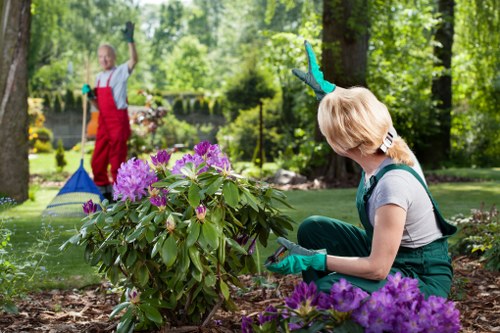 Gardeners Parsons Green is committed to creating an eco-friendly waste disposal area and a sustainable rubbish gardening area that serves both residents and professional gardeners. Our approach balances practical on-site waste reduction with borough-level recycling systems so that compostable material, green waste and recyclable containers don’t end up in landfill. We champion clear separation of streams and local collaboration to reduce carbon impact while improving soil health in community plots.
As Parsons Green gardeners increasingly adopt circular practices, we focus on actionable targets: our operational aim is to reach a 65% recycling percentage target for garden-related waste by 2028, with incremental reviews each year to measure progress. This target includes diverted green waste, food scraps destined for community composting, and properly sorted recyclables like glass, paper and plastics from nursery packaging.
 The borough's approach to waste separation underpins our process: residents and gardeners separate food waste, paper and card, glass and cans, and non-recyclable rubbish. Gardeners at Parsons Green adhere to these bins and also run dedicated garden-waste collections for prunings, turf and woody cuttings. We promote on-site composting and mulching to reduce the volume of transported waste and to close the nutrient loop within local green spaces.
Local Transfer Stations and Low-Carbon Logistics
We make use of nearby local transfer stations and consolidation points to keep transport efficient and low-emission. Materials that cannot be processed on-site are taken to borough transfer facilities and partner transfer stations in neighbouring areas for sorting and onward processing. This creates a reliable route for mixed recycling and bulky garden waste while reducing multiple van trips across the city.
 Our logistics plan emphasises low-carbon vans: a growing fleet of electric and hybrid vehicles, supplemented by cargo bikes for short runs, reduces diesel mileage in narrow residential streets. These low-carbon vans are used for collection, delivery of compost and soil, and for moving bulk recycled materials to transfer stations — cutting emissions and noise pollution in the community.
We also coordinate load consolidation to minimise trips. Eco-friendly waste disposal area practices include scheduled collections, grouping of pick-ups by neighbourhood blocks, and using re-usable sacks and bulk bins to reduce single-use disposal bags. This approach limits contamination of recyclable streams and reduces the carbon footprint per tonne of material moved.
Partnerships with Charities and Community Organisations
Partnerships are central to our sustainability model. We work with local charities and redistribution networks — including food redistribution schemes and community garden projects — to give surplus materials a second life. Textile and tool donations are channelled to charities and repair cafes, while viable plants and surplus soil are allocated to community plots and educational initiatives.
 Our collaborations typically include:
- Food redistribution partners who take surplus edible produce from community allotments and garden events.
- Local social enterprises that refurbish garden tools and re-sell or donate them.
- Community compost hubs that accept green waste and return finished compost for local reuse.
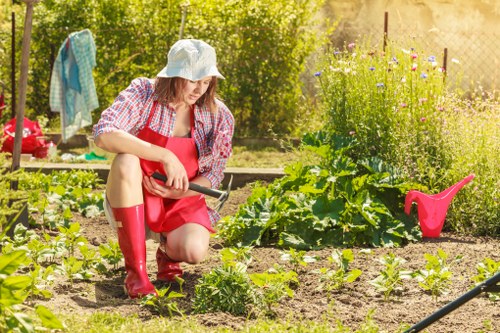 In practice, gardeners at Parsons Green benefit from a networked system: segregated collections, community composting points, and charity pick-ups reduce waste volumes and boost reuse. We track recycling rates and contamination levels, and use this data to refine training sessions for volunteers and professionals so that the borough's waste separation policies are complemented by on-the-ground good practice.
Practical actions you can adopt today include switching to communal composting, using labeled containers for glass and mixed recycling, and choosing suppliers who return plastic trays and cardboard. Simple steps reduce pressure on transfer stations and help us hit that 65% recycling percentage target.
Measuring success is a continuous process: we publish annual summaries of diverted tonnes, vehicle miles saved through consolidation and electric van use, and partnerships activated. These metrics show progress toward a resilient, local system for gardening waste that aligns with the borough's wider waste separation strategy.
Gardeners Parsons Green is more than a name — it is a collective commitment to an eco-friendly waste disposal area and a thriving sustainable rubbish gardening area. By combining clear recycling targets, smart logistics, transfer station links, charity partnerships and low-carbon vans, we create a model that protects urban green space and reduces the environmental cost of gardening in the city.

